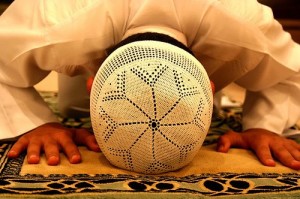
With regard to delaying the prayer, it is not permissible for a Muslim to delay his prayers beyond the time when they are due without a legitimate excuse such as sleeping and forgetting. Work is not an excuse for not praying or for delaying a prayer until its time is over. We read in the Quran what gives the meaning of:
Monday, 11 April 2016
UNABLE TO PRAY AT WORK: WHAT TO DO?
With regard to delaying the prayer, it is not permissible for a Muslim to delay his prayers beyond the time when they are due without a legitimate excuse such as sleeping and forgetting. Work is not an excuse for not praying or for delaying a prayer until its time is over. We read in the Quran what gives the meaning of:
Sunday, 20 March 2016
WOMEN IN HER CHILDHOOD
A girl is very dear to her parents. Before her attaining the age of puberty, she is free from any religious obligation. She is supposed to enjoy her life at her father's house with the single motto; eat, drink and be merry. She enjoys the love and affection of her parents, her sisters, brothers and other relatives. When she starts speaking, the parents should teach her the basics of the religion and faith. The childhood is an age of learning. A child attains considerable amount of knowledge till the age of five that she would never get throughout her life. This is the period when the first schooling of the child starts with her first teacher, The mother.
When the girl is five-year-old, she should be taught lessons of personal hygiene. She should also be given training in human behaviour with special emphasis on adopting good things and discarding bad habits. This is also the time to start her education. The education should start with the learning of the Holy Quraan. She should memorize at least the last few Suras of the 30th Part of the Holy Quraan especially Sura Fateha, Sura An-Naas, Sura Al-Falaq, Sura Ikhlaas, Sura Al-Kafiroon. She should know the Islamic way of purification, Wudu (ablution) and Ghusl (bath).
At the age of seven the girl should be taught the fundamentals of Islam such as Salaah. This is the age when the girl should cultivate the habit of Pardah. She should also be taught washing of utensils, minor stitching jobs and other domestic chores of common nature. She should be suitably admonished for her idling, laziness, carelessness and mischief. She should not be allowed to mingle with the girls and women of low character. She should be kept away from evils of reading romantic literature, seeing movies and listening to music, etc. These evils adversely affect the morale of the child and encourage her to adopt bigger evils.
ADVICE TO THE MUSLIM SISTERS
In this Western world and environment that we live in, we sadly see that Muslim females (teenagers) are the target of the Kufaar. Their aim is to cause Muslim females to lose their respect and integrity, taking them away from a pious and truly fruitful Islamic life. Many Muslims females throughout the world today are caught in the trap of drugs, alcohol, club going, adultery and various other detrimental activities.
My respected Muslim Sisters! Look at what you are doing and see for yourself whether you are causing benefit or harm to your selves?
Think of what you are doing and, then Remember! That Almighty Allah is watching your every action. My dear Muslims sisters! Dress Islamically, Do not try to copy the West. Do not strive to look and dress like the Kufaar. After you leave this world, you being a duplicate of any film or pop-star will not be of any assistance to you in your grave or in the hereafter. Forget and divorce yourself from the traps of the West. Instill in yourself true beauty, true respect and true integrity. Rather than trying to portray a pop-star or any other Kaafir. Portray Sayyida Faatima Zahra (radi Allahu anha), the Blessed daughter of the Prophet (sallal laahu alaihi wasallam). She who will be the Queen of the Maidens of Jannat.
Do you wish to enter Jannah? Do you wish to be in the companionship?
Wednesday, 2 March 2016
SURVIVING AT UNIVERSITY - BY A UNIVERSITY STUDENT
There were beer mats everywhere. The whole corridor was covered in an intriguing pattern of small cardboard squares called Carlsberg. There were eight rooms in the corridor but only one kitchen, one toilet and one shower. I had expected the place to be a bit more lively but my friend explained to me that it was always quiet on Friday and Saturday nights. ‘They invite me along with them as well,’ he said with a sigh, ‘but all I can do is laugh and politely decline.’
Welcome to the world of the university campus, the place where a significant number of Muslim students will spend at least the first year of their university life. Away from home and away from family and friends, the three years on average spent by most students pursuing a degree is a crucial time for the development or deterioration of one’s Imãn. All students whether they choose to remain at home or stay elsewhere experience the onslaught of ‘Fresher’s Week’ before they even begin their studies. Fresher’s Week is supposedly a week full of events designed to allow those beginning their university career to acquaint themselves with their new surroundings as well as with their fellow students. In reality Fresher’s Week is a hedonistic 7 days which the pubs and nightclubs utilise to attract their prospective clientele for the following year. Flyers and posters advertising nightclubs, bank loans, mobile phones and a whole host of other organisations, societies and clubs bombard students during these first few days. Even though the Islamic Societies of most universities make a determined effort to attract Muslim students away from such temptation, it is sad to say that for many Muslims the Islamic Society stall is last on their list of places to visit. Fresher’s Week is a severe trial and only those come through unscathed that have a strong bond and connection with Allah Ta'ala.
When I initially applied to university I remember being told at college that university was a place of experimentation, of experience and of widening one’s views of the world. For a Muslim this experience can be extremely difficult as many of the activities used for this social experimentation are either makrooh or harãm and illegal. Social experimentation and finding the ‘real you’ seem to be prime goals for many students. For Muslims, university can be quite a lonely time as many of the events and functions organised by their peers involve activities which are albeit legal under the laws of this country but illegal i.e. harãm from an Islamic perspective. Promiscuous relationships, ‘pub crawls’ (whereby a number of pubs are visited in one outing) and a whole host of other unbelievable activities are the order of the day. And all this is practiced by those who the rest of society deems as being ‘the leaders of tomorrow’.
I remember my disgust when I initially visited my university at the lack of scope in the lecturer’s jokes. Alcohol and the price of alcohol were the only two topics discussed. It was quite a disturbing experience to be the only sombre person in a room full of 400 laughing 18 year olds. It was not that I did not understand the jokes, it was the fact that drinking and in reality alcoholism were deemed to be an acceptable part of the student lifestyle regardless of a person’s belief. In my opinion, this is the crux of the difficulty for Muslims studying at university; the question of maintaining and retaining a distinct Muslim identity. This is the point where many of us fail as we try to reconcile our faith with the demands and pressures of the environment surrounding us. Do you pray Zuhr Salãh during your lunch hour or do you make it Qadhã and attend that lunchtime optional seminar which might look good on your CV? It is in such matters that students should turn to the ‘Ulamã in order to find out how to reconcile these differences.
And it is during these times that one realises the true advantages of having a spiritual mentor. Having a spiritual mentor or Shaykh to which one can turn to for guidance and encouragement can make all the difference when confronted with a dilemma.
However, many students are unable to do this, mainly because of the fact that the only contact they had with the ‘Ulamã was during their pre-teens when attending the evening maktab. No contact or relationship was maintained with the ‘Ulamã and in many cases with the Deen of Islãm after these initial few years. But, alhamdulillah there are still a significant number of students who do maintain contact, right until and after the time they enter university. Their knowledge and zeal for Islãm can prove to be a boon for others searching for the truth - and there are many searching for and returning to the truth. The number of student reverts and Muslims whose interest in Islãm is reignited while attending university and the existence of student Islamic Societies bears testimony to this.
Islamic Societies are voluntary organisations run by students to cater for the needs of Muslims who may be attending the university or living in its vicinity. They typically provide a prayer room with wudhoo facilities in most cases, and organise a variety of Da‘wah and educational events. Partly funded by money from the university’s student union and partly by private donations, Islamic Societies bring together Muslims from around the world. In my first Jumu‘ah prayer at university I was met with a scene which made me reminisce of how the times of the Prophet sallallahu alaiyhi wasallam must have been. The Imãm was an African, the mu’azzin an Arab, and the remaining rows a mixture of Muslims from almost every other country in the world.
This diversity however, can prove to have a weakness in the sense that it can provide an ideal cover for deviant sects bent on spoiling the Imãn as well as ideology of Muslims. Many students are unaware of these sects and are highly impressed by the seemingly knowledgeable and sincere words of their protagonists. Once again the lack of knowledge regarding our authentic scholars and their achievements causes quite a majority of us to feel inferior when faced with such people.
Another point which surprised me very much was the little effort that was being made on the Muslims at the University. It seemed like Da‘wah was to be practised on non-Muslims only. I attended one of the meetings held to discuss the organisation of the Islamic Awareness Week at the university. Even though I half expected the meeting to be mixed I had not anticipated what I saw. Many of the sisters wore scarves, but the way they and many of the brothers as well, were dressed, left little to the imagination. However most of these sisters were extremely sincere and it soon became obvious that they played a key role in the running of Islamic events at the university. On asking one of the brothers why this was the case he replied that most Muslim male students did not bother volunteering and consequently this void was filled by the sisters. In my opinion this was an extremely dangerous situation as many of the events that were being organised involved the free mixing of males and females albeit with a good intention. This is another point where most of us fail due to our lack of knowledge and correct guidance. We presume we are doing something acceptable in the Sharee‘ah based upon what little knowledge we may have of the Sharee‘ah ourselves.
The brother whom I quoted at the beginning of the article was a clean shaven youngster when he started university. He has since kept a beard. I asked him the reason for this and he replied, ‘I was looking for Muslims and I thought let me look for someone with a beard. The thought suddenly hit me that I myself do not have a beard, would anyone recognise me as a Muslim?’ There are many brothers and sisters who dress in full Islamic clothing when attending university and it can be honestly said that there is probably no greater form of giving Da‘wah to both Muslims and non-Muslims than this; the full adoption of Islãm. As many of us know Allah S has commanded us to enter into Islãm totally. This is what I think is needed for the regeneration of the student community. Rather than trying to unify with university culture Muslims need to be unique, unique both internally in manners and character and externally in dress and appearance, and be proud of this uniqueness. Simplicity coupled with the adoption of the teachings of the Qur’ãn and Sunnah and the ways of the Companions y, under the guidance of the ‘Ulamã, the experts in the field, seems to be the only way to achieve this uniqueness and in reality restore our confidence. Reliable organisations such as the Islãmic Da‘wah Academy and many others are already taking part in this regeneration by holding meetings with student leaders and trying to address their specific needs. More interaction such as this is needed at both school and college/university level.
For me university has proved to be quite a revealing experience in the sense that it has made me appreciate how little many non-Muslims and, in some unfortunate cases, Muslims themselves know about Islãm. For a significant number of non-Muslim students the only contact they have had with Muslims is via the TV or the newspapers i.e. they have never met a Muslim before. We, as Muslim students need to be trained and given the opportunity to learn how to practice and propagate Islãm adequately and to deal with situations which we may have not encountered before in our lives. Only recourse to the ‘Ulamã and the mashã’ikh can help to solve such dilemmas.
We need to take the opportunity to adopt the company of the pious, especially the ‘Ulamã and take part in reliable religious movements so that we gain the true understanding of Islãm. Only then will we become true individuals, independent and free from the shackles of a non-Islamic culture. And only then will we be able to, in the words of the Sahãbi Rib‘ee Ibne Ãmir t, work towards delivering mankind from ‘the slavery of man into the slavery of the Lord of man, and from the narrowness of this world to the vastness of the Hereafter.’
May Allah Ta'ala give the writer first and then the readers the ability and the inclination to practice what has been written. May Allah Ta'ala help all students whether studying in religious or secular institutes to achieve their goals and cause all of us to attain His pleasure and live and die as true Muslims upon Islãm. Ãmeen
GUIDELINES FOR INTERNET USERS
First: When a Muslim hears the call for prayer, he should rise up to the remembrance of Allah and not let anything take him away from answering that call. The Lord SWT said: In houses that Allah ordered to be built and His name to be mentioned in them mornings and nights, men who are not diverted by trade or selling from the Remembrance of Allah, pray, give alms, fear a day where hearts and eyesight's are diverted in all directions. (24:36-37)
Second: The Internet is a way for communication that is considered a double-edged weapon. When it provides benefit, it becomes a gift. And when it provides evil, it becomes a disgrace. Muslim should use the good side of this facility to serve his religion and life, rather than its evil side that corrupts his religion and life.
Third: It's very important for internet users to protect their eyes from falling on prohibited sites. The prohibited scene is considered Satan's arrow, his weapon that he uses to spoil the Muslims heart by offering immediate pleasure, followed by long lasting feelings of remorse and regret. Watching scenes that Allah prohibited causes darkness in the heart, gloominess in the chest and heaviness and reluctance to perform actions of worshiping Allah. It deprives the soul of enjoying the sweetness of deep faith. By all means it is a tool that Satan uses to sugar coat sins with, and the moment one falls in this trap, Satan takes complete control of his heart, and play with it like a young boy who plays with a ball. The end is always a fatal loss.
Fourth: Don't let the internet consume your effort and time for no value. That happens when you navigate between the various sites and online groups for long hours. You waste your precious lifetime hours. That time that you should devote for people like your family, parents, children and relatives, or for your job where you earn the living for you and your dependants.
Fifth: Visit the Islamic Sites frequently. Visit the useful sites that add to your useful information, and widens up your scales of knowledge. Stay away from the sites that promote corruption to Belief or Morals, those groups that seek the spread of Fitnah or controversy, even if this is over religious issues. Bad controversy is of no avail. Don't interfere in conversations with the enemies of Islam unless you have the necessary knowledge and power that enables you to handle this task. And if not, ask a scholar to handle it instead.
Sixth: Take caution against the chatting sites. They are traps for males and females to drag them into a prohibited relationship, which often starts by an innocent introduction and end up in mere pain and causes damage to life and faith.
Seventh: Its either you control or you get controlled by the trap of the internet. If you put it under your control, you take its benefit and shed away its harm. Hence Internet becomes a gift from Allah for your welfare. And if you fall under its control, it blurs your eyes with its glittering charm and temporary pleasures, steals your money, time, life and the duties your have towards your family and beloved ones. You become the prey without being aware of it. Save yourself from this trap before you are lost, and before it is too late.
3 STAGES OF TAHAJJUD
One of the most virtuous of the nawafil acts of worship is waking up in the middle of the night for tahajjudprayer. This is that special time when the doors of mercy are thrown open and the angels are dispersed, seeking out those in need of their Lord. Yet, how unfortunate our situation is that we are deprived from this great bounty.
“Their sides shun their beds in order to pray to their Lord in fear and hope…” (Quran, 32: 16)
Abu Hurayrah (radiallahu anhu) narrates that the Messenger of Allah (sallallahu alaihi wa sallam) said, “The best prayer after the obligatory prayers is the night prayer.” (Muslim)
I remember anytime one of the narrations regardingtahajjud would come up in a text, or was mentioned by one of our teachers, the students would eagerly ask how they could become regular in this blessed act. Here are a few suggestions based on their responses.
Stage 1 – I just can’t wake up
Despite your best efforts (asking a friend to call, multiple alarms, sleeping early, making a firm intention at night, etc.) if you simply cannot force yourself to get up, pray your tahajjud prayer before you go to sleep. Its time technically begins after Isha, so this can be a means of showing Allah that you are serious, and truly desirous of this great bounty. Couple this with dua admitting your inability and asking Allah for His bounty.
Stage 2 – I am sporadic in my tahajjud
If you are blessed to wake up for tahajjud on occasion, or get up most days, but miss a few here and there, be sure to “make-up” the prayer on the days that you don’t get up. And of course couple this with dua.
Umar (radiallahu anhu) narrates that “I heard the Messenger of Allah (sallallahu alaihi wa sallam) say, ‘Whenever one of you sleeps through his night devotions, or through a part of them, then, if you perform them between the Fajr (i.e after Ishraq) and Dhuhr prayer, you will receive the same reward as if you performed them at night.’” (Muslim)
Stage 3 – I regularly wake up for tahajjud
Alhamdulillah, if you are at this stage you need to ensure 3 things:
1. Give shukr every night that Allah allowed you take advantage of this great blessing.
2. Admit to Allah that while you are unworthy of such a blessing, you are in need of it.
3. Beg Allah that He allow you to wake up the following night as well.
May Allah, Most High, allow each of us to be regular in our tahajjud prayers!
Tuesday, 1 March 2016
WHY ARE MOST OF THE MUSLIMS FUNDAMENTALISTS AND TERRORISTS?
Answer:
This question is often hurled at Muslims, either directly or indirectly, during any discussion on religion or world affairs. Muslim stereotypes are perpetuated in every form of the media accompanied by gross misinformation about Islam and Muslims. In fact, such misinformation and false propaganda often leads to discrimination and acts of violence against Muslims. A case in point is the anti-Muslim campaign in the American media following the Oklahoma bomb blast, where the press was quick to declare a ‘Middle Eastern conspiracy’ behind the attack. The culprit was later identified as a soldier from the American Armed Forces.
Let us analyze this allegation of ‘fundamentalism’ and ‘terrorism’:
1. Definition of the word ‘fundamentalist’
A fundamentalist is a person who follows and adheres to the fundamentals of the doctrine or theory he is following. For a person to be a good doctor, he should know, follow, and practise the fundamentals of medicine. In other words, he should be a fundamentalist in the field of medicine. For a person to be a good mathematician, he should know, follow and practise the fundamentals of mathematics. He should be a fundamentalist in the field of mathematics. For a person to be a good scientist, he should know, follow and practise the fundamentals of science. He should be a fundamentalist in the field of science.
2. Not all ‘fundamentalists’ are the same
One cannot paint all fundamentalists with the same brush. One cannot categorize all fundamentalists as either good or bad. Such a categorization of any fund amentalist will depend upon the field or activity in which he is a fundamentalist. A fundamentalist robber or thief causes harm to society and is therefore undesirable. A fundamentalist doctor, on the other hand, benefits society and earns much respect.
3. I am proud to be a Muslim fundamentalist
I am a fundamentalist Muslim who, by the grace of Allah, knows, follows and strives to practise the fundamentals of Islam. A true Muslim does not shy away from being a fundamentalist. I am proud to be a fundamentalist Muslim because, I know that the fundamentals of Islam are beneficial to humanity and the whole world. There is not a single fundamental of Islam that causes harm or is against the interests of the human race as a whole. Many people harbour misconceptions about Islam and consider several teachings of Islam to be unfair or improper. This is due to insufficient and incorrect knowledge of Islam. If one critically analyzes the teachings of Islam with an open mind, one cannot escape the fact that Islam is full of benefits both at the individual and collective levels.
4. Dictionary meaning of the word ‘fundamentalist’
According to Webster’s dictionary ‘fundamentalism’ was a movement in American Protestanism that arose in the earlier part of the 20th century. It was a reaction to modernism, and stressed the infallibility of the Bible, not only in matters of faith and morals but also as a literal historical record. It stressed on belief in the Bible as the literal word of God. Thus fundamentalism was a word initially used for a group of Christians who believed that the Bible was the verbatim word of God without any errors and mistakes.
According to the Oxford dictionary ‘fundamentalism’ means ‘strict maintenance of ancient or fundamental doctrines of any religion, especially Islam’.
Today the moment a person uses the word fundamentalist he thinks of a Muslim who is a terrorist.
5. Every Muslim should be a terrorist
Every Muslim should be a terrorist. A terrorist is a person who causes terror. The moment a robber sees a policeman he is terrified. A policeman is a terrorist for the robber. Similarly every Muslim should be a terrorist for the antisocial elements of society, such as thieves, dacoits and rapists. Whenever such an anti-social element sees a Muslim, he should be terrified. It is true that the word ‘terrorist’ is generally used for a person who causes terror among the common people. But a true Muslim should only be a terrorist to selective people i.e. anti-social elements, and not to the common innocent people. In fact a Muslim should be a source of peace for innocent people.
6. Different labels given to the same individual for the same action, i.e. ‘terrorist’ and ‘patriot’
Before India achieved independence from British rule, some freedom fighters of India who did not subscribe to non-violence were labeled as terrorists by the British government. The same individuals have been lauded by Indians for the same activities and hailed as ‘patriots’. Thus two different labels have been given to the same people for the same set of actions. One is calling him a terrorist while the other is calling him a patriot. Those who believed that Britain had a right to rule over India called these people terrorists, while those who were of the view that Britain had no right to rule India called them patriots and freedom fighters.
It is therefore important that before a person is judged, he is given a fair hearing. Both sides of the argument should be heard, the situation should be analyzed, and the reason and the intention of the person should be taken into account, and then the person can be judged accordingly.
7. Islam means peace
Islam is derived from the word ‘salaam’ which means peace. It is a religion of peace whose fundamentals teach its followers to maintain and promote peace throughout the world.
Thus every Muslim should be a fundamentalist i.e. he should follow the fundamentals of the Religion of Peace: Islam. He should be a terrorist only towards the antisocial elements in order to promote peace and justice in the society.
HOW CAN ISLAM BE CALLED THE RELIGION OF PEACE WHEN IT WAS SPREAD BY THE SWORD?
Answer:
It is a common complaint among some non-Muslims that Islam would not have millions of adherents all over the world, if it had not been spread by the use of force. The following points will make it clear, that far from being spread by the sword, it was the inherent force of truth, reason and logic that was responsible for the rapid spread of Islam.
1. Islam means peace.
Islam comes from the root word ‘salaam’, which means peace. It also means submitting one’s will to Allah (swt). Thus Islam is a religion of peace, which is acquired by submitting one’s will to the will of the Supreme Creator, Allah (swt).
2. Sometimes force has to be used to maintain peace.
Each and every human being in this world is not in favour of maintaining peace and harmony. There are many, who would disrupt it for their own vested interests. Sometimes force has to be used to maintain peace. It is precisely for this reason that we have the police who use force against criminals and anti-social elements to maintain peace in the country. Islam promotes peace. At the same time, Islam exhorts it followers to fight where there is oppression. The fight against oppression may, at times, require the use of force. In Islam force can only be used to promote peace and justice.
3. Opinion of historian De Lacy O’Leary.
The best reply to the misconception that Islam was spread by the sword is given by the noted historian De Lacy O’Leary in the book "Islam at the cross road" (Page 8):
"History makes it clear however, that the legend of fanatical Muslims sweeping through the world and forcing Islam at the point of the sword upon conquered races is one of the most fantastically absurd myth that historians have ever repeated."
4. Muslims ruled Spain for 800 years.
Muslims ruled Spain for about 800 years. The Muslims in Spain never used the sword to force the people to convert. Later the Christian Crusaders came to Spain and wiped out the Muslims. There was not a single Muslim in Spain who could openly give the adhan, that is the call for prayers.
5. 14 million Arabs are Coptic Christians.
Muslims were the lords of Arabia for 1400 years. For a few years the British ruled, and for a few years the French ruled. Overall, the Muslims ruled Arabia for 1400 years. Yet today, there are 14 million Arabs who are Coptic Christians i.e. Christians since generations. If the Muslims had used the sword there would not have been a single Arab who would have remained a Christian.
6. More than 80% non-Muslims in India.
The Muslims ruled India for about a thousand years. If they wanted, they had the power of converting each and every non-Muslim of India to Islam. Today more than 80% of the population of India are non-Muslims. All these non-Muslim Indians are bearing witness today that Islam was not spread by the sword.
7. Indonesia and Malaysia.
Indonesia is a country that has the maximum number of Muslims in the world. The majority of people in Malaysia are Muslims. May one ask, "Which Muslim army went to Indonesia and Malaysia?"
8. East Coast of Africa.
Similarly, Islam has spread rapidly on the East Coast of Africa. One may again ask, if Islam was spread by the sword, "Which Muslim army went to the East Coast of Africa?"
9. Thomas Carlyle.
The famous historian, Thomas Carlyle, in his book "Heroes and Hero worship", refers to this misconception about the spread of Islam: "The sword indeed, but where will you get your sword? Every new opinion, at its starting is precisely in a minority of one. In one man’s head alone. There it dwells as yet. One man alone of the whole world believes it, there is one man against all men. That he takes a sword and try to propagate with that, will do little for him. You must get your sword! On the whole, a thing will propagate itself as it can."
10. No compulsion in religion.
With which sword was Islam spread? Even if Muslims had it they could not use it to spread Islam because the Qur’an says in the following verse:
"Let there be no compulsion in religion,Truth stands out clear from error" [Al-Qur’an 2:256]
11. Sword of the Intellect.
It is the sword of intellect. The sword that conquers the hearts and minds of people. The Qur’an says in Surah Nahl, chapter 16 verse 125:
"Invite (all) to the way of thy Lord with wisdom and beautiful preaching; and argue with them in ways that are best and most gracious." [Al-Qur’an 16:125]
12. Increase in the world religions from 1934 to 1984.
An article in Reader’s Digest ‘Almanac’, year book 1986, gave the statistics of the increase of percentage of the major religions of the world in half a century from 1934 to 1984. This article also appeared in ‘The Plain Truth’ magazine. At the top was Islam, which increased by 235%, and Christianity had increased only by 47%. May one ask, which war took place in this century which converted millions of people to Islam?
13. Islam is the fastest growing religion in America and Europe.
Today the fastest growing religion in America is Islam. The fastest growing religion in Europe in Islam. Which sword is forcing people in the West to accept Islam in such large numbers?
14. Dr. Joseph Adam Pearson.
Dr. Joseph Adam Pearson rightly says, "People who worry that nuclear weaponry will one day fall in the hands of the Arabs, fail to realize that the Islamic bomb has been dropped already, it fell the day MUHAMMED (pbuh) was born".
HEREAFTER - LIFE AFTER DEATH
Question
How can you prove the existence of hereafter, i.e. life after death?
Answer
1. Belief in the hereafter is not based on blind faith?
Many people wonder as to how a person with a scientific and logical temperament, can lend any credence to the belief of life after death. People assume that anyone believing in the hereafter is doing so on the basis of blind belief.
My belief in the hereafter is based on a logical argument.
2. Hereafter a logical belief
There are more than a thousand verses in the Glorious Qur’an, containing scientific facts (refer my book "Qur’an and Modern Science-Compatible or Incompatible?"). Many facts mentioned in the Qur’an have been discovered in the last few centuries. But science has not advanced to a level where it can confirm every statement of the Qur’an.
Suppose 80% of all that is mentioned in the Qur’an has been proved 100% correct. About the remaining 20%, science makes no categorical statement, since it has not advanced to a level, where it can either prove or disprove these statements. With the limited knowledge that we have, we cannot say for sure whether even a single percentage or a single verse of the Qur’an from this 20% portion is wrong. Thus when 80% of the Qur’an is 100% correct and the remaining 20% is not disproved, logic says that even the 20% portion is correct. The existence of the hereafter, which is mentioned in the Qur’an, falls in the 20% ambiguous portion which my logic says is correct.
3. Concept of peace and human values is useless without the concept of hereafter
Is robbing a good or an evil act? A normal balanced person would say it is evil. How would a person who does not believe in the hereafter convince a powerful and influential criminal that robbing is evil?
Suppose I am the most powerful and influential criminal in the world. At the same time I am an Intelligent and a logical person. I say that robbing is good because it helps me lead a luxurious life. Thus robbing is good for me.
If anybody can put forward a single logical argument as to why it is evil for me, I will stop immediately. People usually put forward the following arguments:
a. The person who is robbed will face difficulties
Some may say that the person who is robbed will face difficulties. I certainly agree that it is bad for the person who is robbed. But it is good for me. If I rob a thousand dollars, I can enjoy a good meal at a 5 star restaurant.
b. Someone may rob you
Some people argue that someday I may be robbed. No one can rob me because I am a very powerful criminal and I have hundreds of bodyguards. I can rob anybody but nobody can rob me. Robbing may be a risky profession for a common man but not for an influential person like me.
c. The police may arrest you
Some may say, if you rob, you can be arrested by the police. The police cannot arrest me because I have the police on my payroll. I have the ministers on my payroll. I agree that if a common man robs, he will be arrested and it will be bad for him, but I am an extraordinarily influential and powerful criminal.
Give me one logical reason why it is bad for me and I will stop robbing.
d. Its easy money
Some may say its easy money and not hard-earned money. I agree completely that it is easy money, and that is one of the main reasons why I rob. If a person has the option of earning money the easy as well as the hard way, any logical person would choose the easy way.
e. It is against humanity
Some may say it is against humanity and that a person should care for other human beings. I counter argue by asking as to who wrote this law called ‘humanity’ and why should I follow it?
This law may be good for the emotional and sentimental people but I am a logical person and I see no benefit in caring for other human beings.
f. It is a selfish act
Some may say that robbing is being selfish. It is true that robbing is a selfish act; but then why should I not be selfish? It helps me enjoy life.
1. No logical reason for robbing being an evil act
Hence all arguments that attempt to prove that robbing is an evil act are futile. These arguments may satisfy a common man but not a powerful and influential criminal like me. None of the arguments can be defended on the strength of reason and logic. It is no surprise that there are so many criminals in this world.
Similarly raping, cheating etc. can be justified as good for a person like me and there is no logical argument that can convince me that these things are bad.
2. A Muslim can convince a powerful and influential criminal
Now let us switch sides. Suppose you are the most powerful and influential criminal in the world, who has the police and the ministers on his payroll. You have army of thugs to protect you. I am a Muslim who will convince you that robbing, raping, cheating, etc. are evil acts.
Even if I put forth the same arguments to prove that robbing is evil the criminal will respond the same way as he did earlier.
I agree that the criminal is being logical and all his arguments are true only when he is the most powerful and influential criminal.
3. Every human being wants justice
Each and every human being desires justice. Even if he does not want justice for others he wants justice for himself. Some people are intoxicated by power and influence and inflict pain and suffering on others. The same people, however, would surely object if some injustice was done to them. The reason such people become insensitive to the suffering of others is that they worship power and influence. Power and influence, they feel, not only allows them to inflict injustice on others but also prevents others from doing likewise to them.
4. God is Most Powerful and Just
As a Muslim I would convince the criminal about the existence of Almighty God (refer to answer proving the existence of God). This God is more powerful than you and at the same time is also just. The Glorious Qur’an says:
"Allah is never unjust
In the least degree"[Al-Qur’an 4:40]
5. Why does God not punish me?
The criminal, being a logical and scientific person, agrees that God exists, after being presented with scientific facts from the Qur’an. He may argue as to why God, if He is Powerful and Just, does not punish him.
6. The people who do injustice should be punished
Every person who has suffered injustice, irrespective of financial or social status, almost certainly wants the perpetrator of injustice to be punished. Every normal person would like the robber or the rapist to be taught a lesson. Though a large number of criminals are punished, many even go scot-free. They lead a pleasant, luxurious life, and even enjoy a peaceful existence. If injustice is done to a powerful and influential person, by someone more powerful and more influential than he, even such a person would want that person perpetrators of injustice to be punished.
7. This life is a test for the hereafter
This life is a test for the hereafter. The Glorious Qur’an says:
"He who created DeathAnd life that HeMay try which of you is best in deed;And He is the Exalted In Might, Oft-Forgiving"[Al-Qur’an 67:2]
8. Final justice on day of judgement
The Glorious Qur’an says:
"Every soul shall have A taste of death: And only on the Day Of Judgement shall you Be paid your full recompense. Only he who is saved Far from the Fire And admitted to the Garden Will have attained
The object (of life):For the life of this world Is but goods and chattels Of deception." [Al-Qur’an 3:185]
Final justice will be meted out on the Day of Judgement. After a person dies, he will be resurrected on the Day of Judgement along with the rest of mankind. It is possible that a person receives part of his punishment in this world. The final reward and punishment will only be in the hereafter. God Almighty may not punish a robber or a rapist in this world but he will surely be held accountable on the Day of Judgement and will be punished in the hereafter i.e. life after death.
9. What punishment can the human law give Hitler?
Hitler incinerated six million Jews during his reign of terror. Even if the police had arrested him, what punishment can the human law give Hitler for justice to prevail? The most they can do is to send Hitler to the gas chamber. But that will only be punishment for the killing of one Jew. What about the remaining five million, nine hundred and ninety nine thousand, nine hundred and ninety-nine Jews?
10. Allah can burn Hitler more than six million times in hellfire
Allah say in the Glorious Qur’an:
"Those who rejectOur signs, We shall soonCast into the Fire;As often as their skinsAre roasted through,
We shall change themFor fresh skins' That they may taste The penalty: for AllahIs Exalted in Power, Wise" [Al-Qur’an 4:56]
If Allah wishes he can incinerate Hitler six million times in the hereafter in the hellfire.
11. No concept of human values or good and bad without concept of hereafter
It is clear that without convincing a person about the hereafter, i.e. life after death, the concept of human values and the good or evil nature of acts is impossible to prove to any person who is doing injustice especially when he is influential and powerful.
EATING NON VEGETARIAN FOOD
Question:
Killing an animal is a ruthless act. Why then do Muslims consume non-vegetarian food?
Answer:
‘Vegetarianism’ is now a movement the world over. Many even associate it with animal rights. Indeed, a large number of people consider the consumption of meat and other non-vegetarian products to be a violation of animal rights.
Islam enjoins mercy and compassion for all living creatures. At the same time Islam maintains that Allah has created the earth and its wondrous flora and fauna for the benefit of mankind. It is upto mankind to use every resource in this world judiciously, as a niyamat(Divine blessing) and amanat (trust) from Allah.
Let us look at various other aspects of this argument.
1. A Muslim can be a pure vegetarian
A Muslim can be a very good Muslim despite being a pure vegetarian. It is not compulsory for a Muslim to have non-vegetarian food.
2. Qur’an permits Muslims to have non-vegetarian food
The Qur’an, however permits a Muslim to have non-vegetarian food. The following Qur’anic verses are proof of this fact:
"O ye who believe! Fulfil (all) obligations. Lawful unto you (for food) are all four-footed animals with the exceptions named." [Al-Qur’an 5:1]
"And cattle Hehas created for you (men): from them Ye derive warmth, and numerous benefits, And of their (meat) ye eat." [Al-Qur’an 16:5]
"And in cattle (too) ye have an instructive example: From within their bodies We produce (milk) for you to drink; there are, in them, (besides), numerous (other) benefits for you; and of their (meat) ye eat."[Al-Qur’an 23:21]
3. Meat is nutritious and rich in complete protein
Non-vegetarian food is a good source of excellent protein. It contains biologically complete protein i.e. all the 8 essential amino acid that are not synthesized by the body and should be supplied in the diet. Meat also contains iron, vitamin B1 and niacin.
4. Humans have Omnivorous set of teeth
If you observe the teeth of herbivorous animals like the cow, goat and sheep, you will find something strikingly similar in all of them. All these animals have a set of flat teeth i.e. suited for herbivorous diet. If you observe the set of teeth of the carnivorous animals like the lion, tiger, or leopard, they all have a set of pointed teeth i.e. suited for a carnivorous diet. If you analyze the set of teeth of humans, you find that they have flat teeth as well as pointed teeth. Thus they have teeth suited for both herbivorous as well as carnivorous food i.e. they are omnivorous. One may ask, if Almighty God wanted humans to have only vegetables, why did He provide us also with pointed teeth? It is logical that He expected us to need and to have both vegetarian as well as non-vegetarian food.
5. Human beings can digest both vegetarian and non-vegetarian food
The digestive system of herbivorous animals can digest only vegetables. The digestive system of carnivorous animals can digest only meat. But the digestive system of humans can digest both vegetarian and non-vegetarian food. If Almighty God wanted us to have only vegetables then why did He give us a digestive system that can digest both vegetarian as well as non-vegetarian food?
6. Hindu scriptures give permission to have non-vegetarian food
There are many Hindus who are strictly vegetarian. They think it is against their religion to consume non-vegetarian food. But the true fact is that the Hindu scriptures permit a person to have meat. The scriptures mention Hindu sages and saints consuming non-vegetarian food.It is mentioned in Manu Smruti, the law book of Hindus, in chapter 5 verse 30
"The eater who eats the flesh of those to be eaten does nothing bad, even if he does it day after day, for God himself created some to be eaten and some to be eater."Again next verse of Manu Smruti, that is, chapter 5 verse 31 says
"Eating meat is right for the sacrifice, this is traditionally known as a rule of the gods."Further in Manu Smruti chapter 5 verse 39 and 40 says
"God himself created sacrificial animals for sacrifice, ...., therefore killing in a sacrifice is not killing."Mahabharata Anushashan Parva chapter 88 narrates the discussion between Dharmaraj Yudhishthira and Pitamah Bhishma about what food one should offer toPitris (ancestors) during the Shraddha (ceremony of dead) to keep them satisfied. Paragraph reads as follows:
"Yudhishthira said, "O thou of great puissance, tell me what that object is which, if dedicated to the Pitiris (dead ancestors), become inexhaustible! WhatHavi, again, (if offered) lasts for all time? What, indeed, is that which (if presented) becomes eternal?"
"Bhishma said, "Listen to me, O Yudhishthira, what thoseHavis are which persons conversant with the rituals of the Shraddha (the ceremony of dead) regard as suitable in view of Shraddha and what the fruits are that attach to each. With sesame seeds and rice and barely and Masha and water and roots and fruits, if given atShraddhas, the pitris, O king, remain gratifiedfor the period of a month. With fishes offered at Shraddhas, thepitris remain gratified for a period of two months. With the mutton they remain gratified for three months and with the hare for four months, with the flesh of the goat for five months, with the bacon (meat of pig) for six months, and with the flesh of birds for seven. With venison obtained from those deer thatare calledPrishata, they remaingratified for eight months, and with that obtained from the Ruru for nine months, and with the meat of Gavaya for ten months, With the meat of the bufffalo their gratification lasts for eleven months. With beef presented at the Shraddha, their gratification, it is said , lasts for a full year. Payasa mixed with ghee is as much acceptable to the pitris as beef. With the meat of Vadhrinasa (a large bull) the gratification of pitris lasts for twelve years. The flesh of rhinoceros, offered to thepitris on anniversaries of the lunar days on which they died, becomes inexhaustible. The potherb calledKalaska, the petals of kanchana flower, and meat of (red) goat also, thus offered, prove inexhaustible.
So but natural if you want to keep your ancestors satisfied forever, you should serve them the meat of red goat.
7. Hinduism was influenced by other religions
Though Hindu Scriptures permit its followers to have non-vegetarian food, many Hindus adopted the vegetarian system because they were influenced by other religions like Jainism.
8. Even plants have life
Certain religions have adopted pure vegetarianism as a dietary law because they are totally against the killing of living creatures. If a person can survive without killing any living creature, I would be the first person to adopt such a way of life. In the past people thought plants were lifeless. Today it is a universal fact that even plants have life. Thus their logic of not killing living creatures is not fulfilled even by being a pure vegetarian.
9. Even plants can feel pain
They further argue that plants cannot feel pain, therefore killing a plant is a lesser crime as compared to killing an animal. Today science tells us that even plants can feel pain. But the cry of the plant cannot be heard by the human being. This is due to the inability of the human ear to hear sounds that are not in the audible range i.e. 20 Hertz to 20,000 Hertz. Anything below and above this range cannot be heard by a human being. A dog can hear up to 40,000 Hertz. Thus there are silent dog whistles that have a frequency of more than 20,000 Hertz and less than 40,000 Hertz. These whistles are only heard by dogs and not by human beings. The dog recognizes the masters whistle and comes to the master. There was research done by a farmer in U.S.A. who invented an instrument which converted the cry of the plant so that it could be heard by human beings. He was able to realize immediately when the plant itself cried for water. Latest researches show that the plants can even feel happy and sad. It can also cry.
10. Killing a living creature with two senses less is not a lesser crime
Once a vegetarian argued his case by saying that plants only have two or three senses while the animals have five senses.
Therefore killing a plant is a lesser crime than killing an animal. Suppose your brother is born deaf and dumb and has two senses less as compared to other human beings. He becomes mature and someone murders him. Would you ask the judge to give the murderer a lesser punishment because your brother has two senses less? In fact you would say that he has killed a masoom, an innocent person, and the judge should give the murderer a greater punishment.
In fact the Qur’an says:
"O ye people! Eat of what is on earth, lawful and good" [Al-Qur’an 2:168]
11. Over population of cattle
If every human being was a vegetarian, it would lead to overpopulation of cattle in the world, since their reproduction and multiplication is very swift. Allah (swt) in His Divine Wisdom knows how to maintain the balance of His creation appropriately. No wonder He has permitted us to have the meat of the cattle.
12. Cost of meat is reasonable since all aren’t non-vegetarians
I do not mind if some people are pure vegetarians. However they should not condemn non-vegetarians as ruthless. In fact if all Indians become non-vegetarians then the present non-vegetarians would be losers since the prices of meat would rise.
BASICS OF BECOMING A MUSLIM
Islam is an Arabic word and it connotessubmission, surrender and obedience. As a religion, Islam stands for complete submission and obedience to Allah (God).
Islam, in fact, is an attributive title. Anyone who possesses this attribute, whatever race, community, country or group he or she belongs to, is a Muslim. According to the Qur'an the Holy Book of the Muslims), among every people and in all ages there have been good and righteous people who possessed this attribute - and all of them were and are Muslims.
Islam is a universal and eternal religion. Its appeal is to the whole humanity. Any person who declares belief in La ilaha illallah Muhammad-ur-Rasulullah (there is no deity but Allah, and Muhammad is His Prophet) enters the fold of Islam and entitles him or herself to the same rights as those of other Muslims.
Prophet Muhammad (blessings of Allah and peace be upon him) has enjoined us to believe in five articles of faith:
1) Belief in one God Who has absolutely no associate with Him in His divinity;
2) Belief in God's Angels;
3) Belief in God's Books, and in the Holy Qur'an as His Last Book;
4) Belief in God's Prophets, and in Muhammad (blessings of Allah and peace be upon him) as His Last and Final Messenger; and
5) Belief in life after death.
One who believes in these articles enters the fold of Islam and becomes a member of the Muslim community. But one does not become a complete Muslim by mere vocal profession alone. To become a complete Muslim one has to fully carry out in practice the instructions given by Prophet Muhammad (blessings of Allah and peace be upon him) as ordained by God.
These five articles form the foundation for the superstructure of Islam. Their gist is contained in the short sentence known as Kalimah-tayyibah (also called the Shahada). When you declare La ilaha illallah (their is no deity but Allah), you give up all false deities, and profess that you are a creature of the One God; and when you add to these words Muhammad-ur-Rasulullah (Muhammad is Allah's Messenger) you confirm and admit the Prophethood of Muhammad (blessings of Allah and peace be upon him). With the admission of his Prophethood it becomes obligatory that you should believe in the divine nature and attributes of God, in His angels, in His Revealed Books and life after death, and earnestly follow that method of obeying God and worshipping Him which the Prophet Muhammad (blessings of Allah and peace be upon him) has asked us to follow.
Now let us see what code of conduct Muhammad (blessings of Allah and peace be upon him) has taught as ordained by God Almighty. The first and foremost things in this respect are the 'Ibadah (or worships) - the primary duties which must be observed by each and every person professing to belong to the Muslim community. 'Ibadah is an Arabic word derived from 'Abd (a slave) and it means submission. The concept of 'Ibadah is very wide. All your activities are 'Ibadah if they are in accordance with the law of God and your ultimate objective is to seek the pleasure of God. A set of formal 'Ibadah (worships) are thus the pillars on which the edifice of Islam rests:
1) Salah (prayers) - The most fundamental and the most important of these obligations. Salah are the prescribed daily prayers which consist in repeating and refreshing five times a day the belief in which you repose your faith.
2) Fasting - What prayers seek to do five times a day, fasting in the month of Ramadhan (the ninth month of the lunar year) does once a year. What is it that makes us voluntarily undergo hunger or thirst from dawn to dusk? It is nothing but faith in God and the fear of Him and the Day of Judgment. This consciousness of duty and spirit of patience that incessant fasting during a whole month helps us strengthen our faith.
3) Zakah - Its fundamental importance lies in the fact that it fosters in us the quality of sacrifice and rids us of selfishness and greed. Islam accepts within its fold only those who are ready to give away in God's way some of their wealth willingly. Every Muslim whose finances are above a certain specified minimum must pay 2.5% of their cash balance annually to the deserving.
4) Hajj (pilgrimage) - Mecca, CORRECTLY PRONOUNCED an spelt as MAKKAH today stands at the site of a house that the Prophet Abraham (God's blessing be upon him) built for the worship of Allah. Allah rewarded him by calling it His own House and making it the center towards which all must face when saying prayers. He has also made it obligatory on those who can afford it to visit this place to perform the Hajj , at least once in a lifetime. The pilgrimage is, in a way, the biggest of 'Ibadah. For unless a person really loves God he would never undertake such a long journey .
In the name of Allah (God), the Beneficent, the Merciful.
All Praise is due to Allah (God), Lord of the worlds, the Beneficient, the Merciful, Owner of the Day of Judgement.
Thee alone we worship and Thee alone we ask for help.
Show us the straight path, the path of those whom Thou hast favoured, not (the path of) those who earn Thine anger nor (of) those who go astray. (Amen)
The Holy Qur'an (The Opening Chapter, Al-Fatihah, Surah 1)
CAN ON WHISTLE
There is no specific prohibition as regards to whistling, but in light of the Quran, whistling is not looked upon as a virtue.
Allah Ta'ala says in the Glorious Quran Chapter 8 Surah Anfaal verse 35: Their (the unbeliever’s) prayer at the House (of Allah) is nothing but whistling and clapping of hands: (its only answer can be) "taste ye the penalty because ye blasphemed."
One cannot say that the act of whistling is actually haraam; the most one may say is that it is disliked, and as such the believers must abstain from it.
Any which way one looks at whistling, it is a disliked act. One never whistles at the sound of the Adhaan or the recitation of the Quran! or any Islamically happy event or occurence. Most people whistle at the tune of modern music and songs, or peverts whistle to attract the attention of the opposite sex; both of which are prohibited in Islam.
Therefore; in the above light it would best to refrain from whistling. Allah Ta'ala knows best.
BITTERNESS IS A KILLER.... DON'T POISON YOURSELF WITH IT
We tend to think that circumstances causes us to become bitter, but this is not always the case. Bitterness is something that happens to us, it is a characteristic we develop. To swallow a daily dose of poison would be unthinkable. Yet this is what you do if you awaken each morning with bitter thoughts that belong to the past. You are poisoning your system.
Bitterness is a killer. But who does it hurt? Only you - for who else suffers that gnawing pain which twists and turns deep in your being? Certainly not the one who has wronged you!. He or she probably is not even aware of it. Bitterness depresses the spirits, stifles creativity, weakens the immune system, obstructs happiness and ruins health. As a carrier you are the only one who reaps its adverse consequences so why submit to it?
A bitter person always seems to find a good reason to be bitter: “After all I did, he or she left me...” “My parents all favour my brother - nothing I do will please them...” “That false rumour ruined my chances of promotion...” and the list goes on…Valid reasons, maybe. Painful, certainly! even worthy of some human emotion. But it takes only a little –yes just a little time and effort to work through the pain, hurt, disappointment, sadness or anger. You must process your emotions, regain your balance, change your attitude or seek counsel.
“Wonderful in theory,” a bitter person might say. “But I can't forget.” You can forget; but whether you choose to is another matter. It takes time and effort to re-pattern negative thoughts into the conscious habit of replacing them with positive ones. When we harbour negative emotions towards others or towards ourselves, or when we intentionally create pain for others, we poison our own physical and spiritual systems. By far the strongest poison to the human spirit is the inability to forgive oneself or another person. It disables a person’s emotional resources. The challenge is to refine our capacity to love others as well as ourselves and to develop the power of forgiveness.
“Forgiveness is the key that unlocks the door of resentment and the handcuffs of hate. It is a power that breaks the chains of bitterness and the shackles of selfishness.”
ALLAH TA’ALA knows what's hidden in the deep recesses of our hearts. Those feelings of pain, anguish, resentment, hatred, bitterness, etc., that we so successfully hide from everyone else, including our closest family members and friends. So why not let it all out. Why not let ALLAH TA’ALA be your "therapist". Let your prayer mat be your "couch" while you reveal and ask the One who is in control, Who knows you better than you know yourself. From the very depth of ALLAH TA’ALA'S fountain of Mercy, bitterness will be cleansed and you shall blossom amongst the flowers of enjoyment. Subhaan-ALLAH !
Beloved Reader! It is better to live in peace than in bitterness and strife. I've known people to go through a lot of trials and hardships and maintain a grateful and gracious spirit throughout. I've seen others face similar trials only to become angry and embittered souls. In both the cases the hardship revealed the heart more than it formed the heart. If we are filled with sweetness and something jostles us, then sweetness spills out. If we are filled with bitterness and we get jostled then battery acid goes everywhere. Overcome the obstacles in your path, be determined, courageous and hard-working. Never be faint-hearted. Be resolute, but never bitter... be beautiful inside and thus you shall become an embodiment of love, joy and happiness.
HOW TO DEAL WITH BITTERNESS:
· Most important is to Turn to Allah by means of Dua (Prayer). Raise your hands in supplication, for, Du'a is a weapon of a Believer.· Every time you think of a past negative situation, replace it instantly with a picture of a positive, happy life.· When you feel resentful, bless and forgive the person who wronged you and do not stop praying for the best for those you love.· Busy yourself with things you enjoy so that you have no time to brood. Plan something to look forward to. Give to someone who is worse off than yourself. In other words place every negative thought with a positive one until it becomes a habit.
Never allow bitterness to take root or you'll become a twisted, sour human being people will shun.
Bitter thoughts are like weeds. Pluck them out of your heart relentlessly…and in their place will sprout the seeds of joyful new life.
O ALLAH TA’ALA! Reform our character and bless us with cleanliness of the heart. ..Aameen
Sunday, 28 February 2016
BE THANKFUL FOR WHAT YOU HAVE
Should you find something on your plate that doesn't appeal to you, don't complain. There are people who don't have anything on their plate.
Should you find yourself stuck in traffic, don't despair. There are people in this world for whom driving is an unheard of privilege.
Should you have a bad day at work, think of the man who has been out of work for years.
Should you despair over a relationship gone bad, think of the person who has never known what it's like to love and be loved in return.
Should you grieve the passing of another weekend, think of the woman in dire straits, working twelve hours a day, seven days a week to feed her children.
Should your car break down, leaving you miles away from assistance, think of the paraplegic who would love the opportunity to take that walk.
Should you notice a new gray hair in the mirror, think of the cancer patient in chemo who wishes he/she had hair to examine.
Should you find yourself at a loss and pondering what is life all about, asking what is my purpose? Be thankful. There are those who didn't live long enough to get the opportunity.
Should you find yourself the victim of other people's bitterness, ignorance, smallness or insecurities, remember, things could be worse. You could be them!
Saturday, 27 February 2016
THEN WHY DON'T YOU EAT PORK
Once a Muslim scholar was delivering a lecture about Halaal and Haraam in Islam. One man from the audience rose and asked, “Sir! Why do you eat sheep, cow etc ?”
The scholar replied that, “Allah has made them halal for us. They are all humble creations of Allah”.
The man then asked sarcastically, “Then why don’t you eat pork? Even the pig is very humble. It always has its head down when it walks. Even it will give you a lot of meat as the sheep, cow etc”.
The scholar paused for a moment and asked the guy, “Are you married ?”.
The man replied, “Yes”.
The scholar then asked, “Is she your relative”.
The man replied, “Yes. She is the daughter of…..cousin of…. ….my mother’s relative”.
The scholar then asked, “Why do you have to search and marry such a distant relative ???. Even your mother and sister have the same features what she has. Then why don’t you cohabit with your mother and sister and have your children, rather than doing it with such a stranger” ???
The man’s face turned red.
The scholar then said,
“Son! Allah in his divine wisdom has made certain things halal and certain others Haraam. We can’t use our trivial intelligence and logic to question those things”.
HOW TO MAKE YOUR CHILDREN PERFORM SALAAH ON THEIR OWN WITHOUT REMINDING THEM
My Daughter was 12 years old and salaah was like a heavy burden on her. One day I told her to perform her salaah and I watched her go off. She took her musalla and threw it on the ground. I asked her if she read her salaah and she replied, “yes.” I was devastated as I knew she was lying to me. I watched her closely and knew that she hadn’t performed her salaah. Believe me, without feeling I slapped her across her face. I know I shouldn’t have reacted with aggression but I was upset with her attitude. The situation has troubled me and I cried and I repented to Allah Ta’ala to forgive me. The slap, the talks, the reminders, all did not benefit my child in the least.
One day, one of my friends told me that she once went to visit one of her friends. Her friend was not very pious, but when the azaan was called out, she noticed her children rushing for salaah without any reminders or quarrels.
Quite shocked at what I saw, I asked her how her children perform salaah on their own without quarreling or a reminding them. She said to me, “My secret is that before I got married I make this Dua daily until today.
After she advised me to also read this dua, I also began reciting it daily. My Sisters and Brothers! Since I began to recite this dua, my daughter is now the first to perform her salaah without any reminders or quarrels. She gets up for Fajr Salaah without any alarms. Her brothers are now also eager to perform salaah without any difficulties. In fact now we have to ask her to wake us up for salaah.
I know You are now eager to know what dua this is.
This dua is in Surah Ibraheem [14], ayah # 40
رَبِّ اجْعَلْنِیۡ مُقِیۡمَ الصَّلٰوۃِ وَمِنۡ ذُرِّیَّتِیۡ ٭ۖ رَبَّنَا وَتَقَبَّلْ دُعَآءِ
O my Lord! make me one who establishes regular Prayer, and also (raise such) among my offspring O our Lord! and accept Thou my Prayer. "Rabbi-Ajal'ni muqeema salaati, wa min Dhurriyyati, rabbana wataqabbal duaa"
Start today, do not wait until you get married and until you have kids - "prevention is better than cure."
Wednesday, 24 February 2016
A GUIDE TO MAINTAIN FAJR SALAT
{And then there followed after them (the prophets) an evil generation who delayed the prayer and followed their lusts. Soon will they face destruction, except he who repents, affirms his faith and does deeds of righteousness} [Soorah Maryam: 59-60]
Introduction
Sufficient it is for me to praise Allah and supplicate Him for peace on those servants of His whom he has chosen. To proceed: I have read this letter entitled "Mending the Rift" and found it to be valuable in the choice of its subject matter. Thanks to Allah, the author succeeded in realising the growing tendency of people to miss the Dawn Prayer in congregation inthe mosque. He noticed with dismay that mosques are getting virtually empty of people at that time, except for a few elderly people and some adults who, with Allah's assistance, found their way back into the mosque. Indeed, even a sizeable majority of these elderly people have stopped coming to the mosque to uphold this prayer in congregation and have grown lazy about the other prayers as well.
Our Prophet (sallallaahu-alaihi-wasallam) is our exemplar who provided the best example in spending long hours of the night in prayer and waking intime for Fajr Prayer. This record was authentically known of him both in his teachings and his living example as he did not like sleeping before Ishaa [night] Prayer and discouraged his followers from useless talk after it. In this he was followed by his companions and all the muslims up to a time not very far from our own days. They knew the reasons which cause laziness and lessen motivation to observe prayers in time (be such prayers Fard [obligatory] or Nafla [optional] and warned people against them so much that some of them are reported to have said: "If you are unable to pray at night, then that is a clear sign that your sins have shackled you and deprived you of good deeds". Al-Hasan al-Basri was once asked: "Why is it that we cannot uphold prayers at night?" He answered: "You are shackled in your own sins".
Motivation is presently lacking among muslims. Otherwise they would not have given in to sleep even if they had to stay awake in the first part of the night. When one of them is required by his work arrangements or for his own worldly benefit to wake early at dawn, he would no doubt take the necessary precaution not to miss his appointment. He will forsake his peace of mind and have a restless sleep just for fear he might be punished or have his salary reduced. When it comes to prayer, they have no excuse especially when in our modern times Allah has provided us with alarm clocks which would be set at any time we wish. The problem therefore, is one of laziness. Such people do not know what they are missing. The Prophet (sallallaahu-alaihi-wasallam) said with respect to those who do not observe Ishaa and Fajr prayers: "Had one of them known that he would find a wholesome meal or two good targets, he would have come for Ishaa prayer."
All in all, for him who sincerely wants to purify his soul from the attributes of the hypocrites, let him steer clear of laziness, be active,put into practice the action inspiring instructions laid out in our religion, accustom himself to take the initiative and realise what he and everybody in his position are missing in terms of the health of the body and great reward from Allah. Only then will his performance improve, Allah willing, and he will make up for what he has missed and follow the lead of the best of generations.
Allah, the Most High and Exalted, is the Provider of success and assistance. Peace and Blessings be upon Prophet Muhammed, his household and followers. Signed, Abdullah Ibn Abdur-Rahmaan al-Jibreen.
The Text
Most surely all praise belongs to Allah, we praise Him and we seek His Aid and Forgiveness. We seek refuge in Allaah from the evils of our souls and from the evils of our actions. Whomsoever Allaah guides there is none to misguides and whomsever He misguides their is none to guide. I send prayers and blessing upon our leader Muhammed with the best of prayers and the most complete submission.
To proceed:
One of the ill-seeming phenomena and most serious precedents boding impending danger and punishment, giving reason to fear and calling for most urgent consideration on our part requiring immediate investigation into its causes and treatment of its symptoms is the fact that a growing number of observers of prayer deliberately shun Fajr prayer in congregation and only perform it at times other than its lawful time.
It may be the case that this is due to their wasting away long hours at night engaged in idle and leisure pursuits. Our ancestors not very long ago used to make a point of going to bed early, to lock their doors after Ishaaprayer and to make their dinner light so as to be able to wake up for Fajr prayer in an energetic state. That is why they led a happy, peaceful and healthy life experiencing the real taste of life.
The advent of modern civilisation spoiled both our religious observances and our worldly arrangements. As a result, we have fallen into laziness and inertia; our bodies grew fat and flabby; we move about less frequently whilst showing a greater readiness to sleep and a marked inability to perform the most trivial of manual actions.
The present paper attempts therefore to suggest ways which may be of help in inducing us to wake up for Fajr Prayer; for instance:
ONE: To make sure to go to bed early as the Prophet (sallallaahu-alaihi-wasallam)used to discourage sleep before performing Ishaa prayer and especially engaging in conversation after it. Certain cases were excepted, some of which are enumerated by Imam Nawawi in his explanation of Muslim's account. Nawawi, may Allaah have mercy upon him says:
The reason why conversation after it is discouraged is the fear lest it leads to staying awake for long , which might induce drowsiness and difficulty with observing night prayers or Subh [dawn] prayer in their permitted, preferred or best times. The topics covered by this restriction are all fulfilling no good useful purpose. However, as to useful verbal activities, such as the pursuit of knowledge, listening to the wise tales of righteous people, talking to one's guest or bride, or members of one's family for the sake of company, interacting with travellers with a view to protect themselves and their goods, embarking on talks designed to conciliate between people or intercede before them in a good cause or to enjoin good and forbid evil and admonish people by pointing to a beneficial course of action to follow etc... there are no such restrictions.
TWO: To be assiduous in observing the Aadaab [good manners prescribed in Islam] as to what to do before sleep such as making Du'aa [supplication], bringing one's palms together, very mildly spitting into them and reciting the last three soorah's of the Qur'aaninto them and them wiping them over one's face, head and body, being physically and religiously pure and performing a two rakah voluntary prayer after wudhoo [ablution]. A muslim has to ask his wife, parents, relatives or neighbours to help waking him up. Once waken up, he should not linger lazily for long in bed, lest he acquiresthe vices of the hypocrites who come to prayer showing ample signs of laziness and lack of enthusiasm.
THREE:To fill one's heart with faith and good deeds. Once faith is alive in the heart, it induces the person to do good deeds and strive unremittingly hard. Faith is like a tree which only yields good fruit when irrigated from the streamlets of good deeds, thus bringing about an improvement both in personal conduct and at the interactional level with society at large. The lack of such streamlets or water supplies proportionately causes faith to wither and wilt. The heart is highly sensitive to external hardening stimuli, such as excess food or drink or aberrations in watching or listening (letting your eyes and ears loose to what is unlawful for them). You should therefore protect your heart from such external allurements.
FOUR: To keep away from Ma'aasi [acts of disobedience to Allah] by protecting the eyes, the tongue, the hearing and all the senses from indulging in the perception of objects that Allah has made unlawful for us. As an alternative, one should concern himself with matters pertaining to the worship of Allaah, such as devoting one's sight to the reading of Allaah's Book, meditating over the creatures that Allaah has created in this universe, reading books of knowledge etc. One member of the rightly guided early generations was asked about the reason why people found it difficult to uphold voluntary prayers at night. He answered: "Your sins have shackled you". No doubt sins can be a major cause for a persons inability to enjoy the blessings of piety. As Imaam Ibn ul-Qayyim said, sins are wounds and some wounds can be fatal.
FIVE: To bear in mind the great reward for attending Fajr prayer in congregation on time, and the strong rebuke for him to fails to observe it and to satisfy its conditions. Uthmaan ibn 'Affaan (radhiyallahu anhu) related:
I heard Allah's Messenger (sallallaahu-alaihi-wasallam) say: "He who prays Ishaa in Jamaa'ah [congregation] is as if he has prayed for half the night. As to him who (also) prays Fajr in congregation, it is as if he has prayed all night." [narrated by Maalik and the wording is that of Muslim who also reported it]
Similarly, Bukhaaaree and Muslim and An-Nasaaee related on the authority of Ibn Mas'ud (radiallaahu-anhu) that he said: The case of a man who slept all the night up to sunrise (without waking up for Fajr) was related to the Prophet (sallallaahu-alaihi-wasallam) whereupon he said: "That was a man in whose ear Shaytaan has urinated", or he said "in both his ears".
The urinating is literally true, as Imaam Qurtubi says, since Shaytaan urinates and has sexual intercourse and procreates in a manner that Allah alone knows (1). To ascertain for yourself the truth of this assertion, look at the faces of those who come to deal in their daily business withouthaving prayed Fajr in congregation at due time; look at their faces at working hours. You will surely ask Allaah for refuge from a lot as miserable as theirs. But, after all what do you expect from a person in whose heart Shaytaan has urinated!!!
SIX: To realise the bad effects resulting from one's failure to pray Fajr, such as the melancholic and depressive state of mind and the loss of many religious and worldly benefits, and the good effects resulting from managing to perform it. In this respect the Prophet (sallallaahu-alaihi-wasallam) said:
"Shaytaan ties three knots on the crown of any one of you in your sleep. He says upon each knot that he ties: "You have a long night before you, therefore sleep". But if you wake up and mention Allah, Most Exalted in remembrance one knot will be untied. If you then make ablution another knot will be undone. If you then proceed to pray the last knot will be disentangled. Thus, you will feel in the morning energetic and in good spirits. Otherwise you will feel in a despicable state, lazy". [narrated by Maalik, Bukhaaree, Muslim and Abu Dawood]
The time following Fajr prayer is full of goodness and blessings. At-Tirmidhee narrated upon the authority of Al Ghamdi that the Prophet (sallallaahu-alaihi-wasallam) said: "O Allah bless my Ummah in its early rising!" and whenever he dispatched an expedition or army he sent them early at the beginning of the day. Sakhr was a merchant who always sent his merchandise early in morning thus, becoming wealthy (3). That is why we find the craftsmen and traders are particular about making good use of this time. Those who sleep up to the late morning have denied themselves the blessings of this early hour.
There are many benefits to the health derived from waking up for Fajr prayer. For instance, the highest proportion of ozone gas (03) in the atmosphere is registered at dawn. It then gradually fades away until comlplete disappearance by sunrise. This gas has a very beneficial effect on the nervous system as it vivifies the brain and energises the muscles such that when a person inhales the beautiful breeze of the dawn, known as the SABAA wind, he will experience a pleasure that is unparalleled at any other time of the day or night (4).
SEVEN: To lose no time to categorically clear yourself from the stigma of hypocrisy. Because of the difficulty of waking for this time, praying Fajr in congregation provides evidence that a person has firm faith and is free from hypocrisy. That is why in a hadeeth narrated by Bukhaaree and Muslim, the Prophet (sallallaahu-alaihi-wasallam) said: "Indeed, the most difficult of prayers to bear, for the hypocrites, are Ishaa [night] and Fajr prayers. If only they knew what they are missing , they would sooner come, even if crawling on their knees".
The most worthy companion, Abdullaah and Ibn Mas'ood (radiallaahu-anhu) asserts "The only one indeed who misses them[i.e. Ishaa and Fajr prayers] is a confirmed hypocrite" (5). Ibn Umar (radiallaahu-anhu) said "When we find a man missing from the Ishaa and Fajr prayers we nurture suspicions about him"
(6)If you want a criterion for evaluating a person's degree of faith and truthfulness monitor his observance of Fajr prayer. If he passes the test, that should be taken as a sign indicating the strength of his Eeman [belief, faith]. Let us then testify to his truthfulness since he managed to achieve the greatest victory over himself and to be superior to the pleasure of sleeping in bed. If he fails the test, this is an index to his weakness in faith, a hardness in his heart, an indulgence in self-gratification and a defeat against his own whims.
How is it then that he who indulges in sleep and misses prayer should conceivably feel comfortable while people are delighting in the mosques in the company of the Qur'aan, listening raptuously to Allaah's message, and basking happily in His gardens. He who prefers the pleasures of the bed to the pleasure of the communion with Allaah is the real loser.
These are a few suggestions to help you wake up for Fajr prayer. May Allah make them useful. Glory be to Allah, Most Exalted over any false attributions and thanks be to Allah, the Lord of all Beings.